
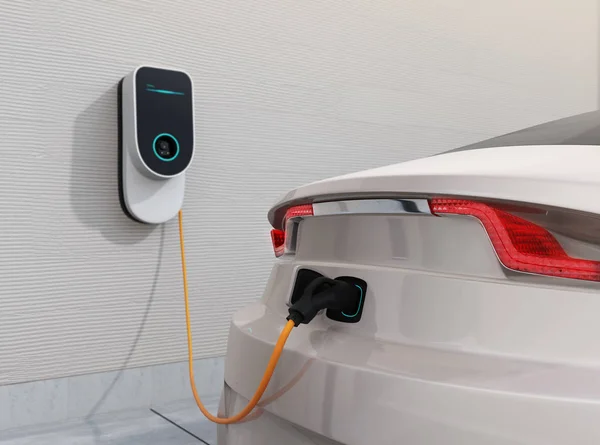
EV Charger Installation
EV Charger InstallationFor Homes Across Stirlingshire,Falkirk, Edinburgh & Glasgow.
Home charge points installed properly the first time — fixed quotes based on your actual cable run and consumer unit, no unrealistic 'from £' pricing that magically doubles on the day.
Fixed quotes · 18th Edition compliant · Certified & guaranteed
Service overview
What it is, who it's for,
and when to book it.
A home EV charger is only as good as the installation behind it. Done properly, it's a set-and-forget appliance that quietly charges the car overnight for the next decade. Done cheaply, it's a monthly source of RCD trips, an expensive smart charger that never quite connects, and — worst case — an installation that fails an EICR two years later.
What the service is
Home EV charger installation covers site survey, load calculation, cable route design and routing, consumer unit upgrade or dedicated circuit installation, charger mounting and commissioning, and full electrical testing and certification. Compatible with all common brands (all major current UK-approved brands).
Who it's for
New EV owners, drivers upgrading from a granny cable to a proper 7kW unit, landlords adding charging to a let property, and homeowners planning ahead as part of a rewire or consumer unit upgrade.
When it's needed
Ideally before the car arrives. Realistically, book as soon as you've placed the order — decent installers are typically 2–4 weeks out, and the survey needs to happen before quoting.
Why professional help matters
EV chargers are one of the highest continuous loads a domestic installation is ever asked to carry — 32A drawn steadily for 6–8 hours at a time. Undersized cable, inadequate protection, or an already-loaded consumer unit will show up quickly under that kind of duty cycle.
The cost of ignoring it
Small electrical issues
rarely stay small.
EV charging is where cheap electrical work exposes itself fastest.
What happens if it's left
- →An undersized cable run on a 7kW charger heats up night after night — the sheath eventually degrades, insulation resistance drops, and the RCD starts tripping mid-charge.
- →Missing Type A + 6mA DC RCD protection (required by BS 7671 for EV charging) is an immediate C2 on any future EICR.
- →Installations that skip the load calculation can trip the main incomer under peak household load — kettle, oven, shower and car all at once.
- →A charger mounted without regard to cable strain relief will fail at the connector within 18 months.
- →Cheap 'installer network' fits can leave you with an unbranded charger that no one supports when it stops working.
Common mistakes to avoid
- ×Assuming the existing consumer unit has spare capacity without a proper load calculation.
- ×Placing the charger at the closest point to the board rather than the most useful point for the driveway.
- ×Buying the cheapest charger without checking smart-tariff / app compatibility if scheduled overnight charging matters to you.
- ×Skipping the site survey and accepting a 'from £' quote sight-unseen — the on-the-day quote is almost always higher.
Our process
A predictable five-step
process — every job.
No surprises, no vague timelines. You'll know what's happening at each stage and what comes next.
-
Step 1
Site Survey
Physical look at the consumer unit, the incoming supply, the earthing arrangement, and — critically — the actual cable route from board to charger location. Photos taken to keep the quote accurate.
-
Step 2
Fixed Quote & Charger Choice
A fixed price is issued covering the charger, all cabling, mounting, board upgrade if required, and testing. If you haven't chosen a charger, honest recommendations based on your car, tariff and use pattern.
-
Step 3
Installation Day
Cable routed cleanly (clipped, trunked or buried as agreed), dedicated RCBO fitted in the board (or new board fitted where quoted), charger mounted and commissioned, network / app configured on the spot.
-
Step 4
Testing & Verification
Full BS 7671 testing on the new circuit — insulation resistance, loop impedance, RCD trip times including the DC-detection function on the charger itself.
-
Step 5
Handover, Certification & Guarantee
Electrical Installation Certificate issued the same day, walk-through of the charger's app / scheduling / tariff integration, and 1-year workmanship guarantee on the labour.
Why customers stay with Electrust
Six practical benefits,
measured on real jobs.
Speed
Most straightforward installs complete in a single day. Even installs paired with a board upgrade rarely exceed a day and a half.
Safety
Correct cable sizing, proper RCBO protection with DC-fault detection where required, and secure mounting with strain relief on the cable.
Longevity
A properly-sized 7kW install will comfortably carry 10+ years of nightly charging without the cable ever getting warm.
Cost Savings
Correct install first time — no return visits for tripping, no charger warranty voided by installation faults, no wasted charge cycles.
Reliability
Dedicated RCBO means the charger has its own protection — no tripping the whole house because the freezer had a wobble.
Peace Of Mind
Fully certified, insured, guaranteed and ready for a future EICR to sign off cleanly.
The detail
Materials, methods
and the situations that shape them.
The technical decisions that separate a proper install from a cheap one.
Cable Sizing & Route
6mm² or 10mm² twin-and-earth (or SWA where run outdoors / buried) sized to the actual length of the run and the continuous 32A load. Long runs from board to driveway are the single biggest reason cheap quotes underspecify cable.
Protection: Type A + 6mA DC RCD
BS 7671 requires either a Type B RCD upstream or a Type A RCD combined with a 6mA DC-fault detection device — the latter is now built into most modern chargers, but not all. Correct combination is verified on install.
Consumer Unit Considerations
Older boards often have no space, no correct RCD type, or an inadequate main switch. Options: dedicated RCBO in an existing modern board, secondary sub-board for the charger circuit, or a full consumer unit upgrade — quoted transparently with all three costs where relevant.
Earthing Arrangements
Most Central Belt properties are TN-C-S (PME). Charger installs on PME earthing require either a PEN-loss protection device (built into most modern chargers) or an earth rod (TT conversion for the charger only). Verified as part of the survey.
Load Management
Where the incoming supply is limited (older properties, 60A main fuses), a load-managed charger — one that dynamically reduces charge rate when household load spikes — avoids needing a supply upgrade from the DNO.
Charger Brands
Any current UK-approved brand fitted — you choose based on features (solar integration, dynamic tariff support, RFID access) and Electrust installs it correctly. Genuine impartial advice available if you'd rather delegate the choice.
FAQ
Straight answers before
you pick up the phone.
Still unsure? Call 07568 558466 — the phone's answered 7am–10pm, 7 days.
How much does an EV charger installation cost?+
Every install is quoted fixed after a site survey — cost is driven by cable length, whether the consumer unit needs upgrading, and any earthing / DNO considerations. No 'from £' pricing that changes on the day.
How long does the install take?+
Most straightforward installs are a single day. Installs paired with a consumer unit upgrade run into a day and a half.
Do I need to upgrade my consumer unit?+
Sometimes. Older boards often lack space or the right RCD type. This is assessed on the survey and priced transparently either way.
Which charger should I buy?+
Depends on your car, tariff, and whether you want solar integration or smart scheduling. Impartial recommendations available on the survey — the install cost doesn't change based on which brand you pick.
How long will the installation last?+
The electrical installation itself is designed for 25+ years. The charger unit itself typically carries a 2–3 year manufacturer warranty and has an expected service life of around 10 years.
Is EV charging safe overnight?+
Yes — that's exactly the duty cycle a properly-installed 7kW charger is designed for. Overnight scheduled charging on a cheap tariff is the intended use case.
Do you carry out load calculations and testing on every install?+
Yes — every EV install includes a load calculation on the incoming supply, correct RCBO/RCD protection, and full BS 7671 testing with certification issued on completion.
Do you cover Edinburgh and Glasgow for EV chargers?+
Yes — regularly. EV charger installs are typically full-day jobs so travel time is well within the working day.
Related services
You might also need…
Consumer Unit Upgrades
A modern 18th Edition consumer unit with RCBO protection on every circuit — fitted in a day, tested, certified and left as tidy as we found it.
Learn moreHouse Rewiring
Full or partial rewires planned around the household — routed cleanly, chased minimally, tested rigorously and finished with a compliant modern consumer unit ready for the next 30 years.
Learn moreDomestic Electrician
One qualified electrician on every job — quoted honestly, priced fixed where possible, finished cleanly and backed by a 1-year workmanship guarantee.
Learn moreGet a free quote
New EV on the way? Let's get the charger installed properly.
Fixed quote after a site visit — no on-the-day surprises. Call 07568 558466 or send your address below.